



How Praecipio Runs 7-10 Marketing Campaigns a quarter with Jira & Claude
 Overview
Praecipio is an Atlassian Platinum Solutions Partner and the 2025 Atlassian Partner of the Year, so when our own marketing team chooses how to run its work, the choice is a statement. Our small but lean team manages ad campaigns and events from within a single Jira space (formerly called a ‘Project’), then pairs that space with Claude to absorb the administrative work that used to eat into every quarter.
The result is a marketing operation that stays visible, reviewed, and reimbursable without adding headcount. Every task has an owner, every deadline is visible, and every public-facing piece gets two sets of eyes. Here’s how we run it.
 Challenge
A lean marketing team carries an enterprise-sized workload. Campaigns, webinars, dinners, and workshops overlap, and each one arrives with its own assets, approvals, and deadlines. Without one shared system, the questions pile up fast: Who owns this? When is it due? Has anyone else read the copy?
Partner funding raised the stakes. Partners reimburse our Market Development Fund (MDF) spend only when we submit the right evidence: proof of performance, receipts for money spent, and leads generated in HubSpot. Claim numbers and amounts live in Google Sheets. Every quarter, someone had to pull those threads together, build the tracking in Jira, and assemble a home for the submission. It was necessary, repetitive, and easy to get subtly wrong.
Finally, marketing work doesn’t only start inside the marketing team. Colleagues across Praecipio need campaigns, content, and event support, and those requests needed a front door that didn’t run through someone’s inbox.
 Solution
One space, one structure.
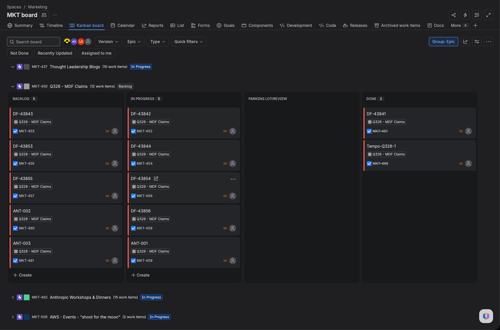
Every marketing initiative lives in a single Jira space. Each starts as an epic, with tasks (and subtasks where the work demands it) that name an assignee and a deadline. Anyone can see what’s planned, who has it, and when it’s due.
Four lanes, two sets of eyes, and a deliberate pause.
Work moves through just four statuses: To Do, In Progress, Review/Parking Lot, and Done/Cancelled. We kept the workflow small on purpose. Review/Parking Lot does the heaviest lifting. Nothing public-facing goes public without two sets of eyes on copy, message, tone, and quality, so a task that reaches this status gets a second team member assigned as reviewer. The same lane covers work waiting for someone outside the team; a comment on the task says who and what we’re waiting for. The pause is a feature, not a bottleneck: reviewers see exactly what’s waiting and why, and the task stays visible instead of vanishing into an email thread.
A Claude skill that knows the MDF playbook
We built a custom Claude skill, a reusable set of instructions for Claude to complete a task, that understands the parameters of our partner’s MDF program and what must be submitted for reimbursement. It reads across the places that information lives, including the Google Sheets that track claim numbers and amounts and Hubspot for leads, then builds the corresponding epic and tasks within Jira and Confluence to house everything needed for submission. The setup that once demanded a careful hunt through spreadsheets and folders now begins as a complete draft that a person verifies instead of builds.
A front door for internal requests
A separate Jira Service Management space, surfaced through Praecipio’s internal service request portal, takes in marketing requests from across the company. Requests are triaged like any service management queue, then flow into the same team and the same four lanes. Requesters get a clear path in; the team gets a prioritized queue instead of scattered asks.
 Results
The Claude skill alone saves the team three to four hours of administrative setup each quarter and consistency is an additional win. Every quarter’s MDF claims start from the same structure, with the same evidence checklist and one Confluence page ready for submission, so nothing that earns reimbursement slips through the cracks.
The rest of the system compounds that gain:
- 7 to 10 campaigns and events per quarter, each managed as epics in a single Jira space per quarter, with all tasks carrying an owner and deadline
- 100% of public-facing assets passing through a second-reviewer step before launch
- 15-25 internal requests triaged per quarter, with a near-immediate time to first response
- More than $100,000 in MDF reimbursement claims submitted per quarter, filed on schedule.
For a team our size, that is the point. Jira gives the work its shape and Claude removes the toil around it, which frees people to spend their hours on the creative and strategic work only they can do. Claude handles the assembly; people retain the judgment.
It’s also the same approach we bring to clients: start with a clear structure, add governance where it protects quality, and automate the work no-one should be doing manually. Next, we’ll extend the skill approach to other recurring workflows across the marketing team.


