


OVERVIEW: GETTING AHEAD OF USAGE-BASED PRICING
How a read-only usage assessment helped a global cybersecurity company find a 68% reduction in Jira automation usage, weeks before Atlassian’s first overage invoices.
When Atlassian announced that overage billing for automation would begin on December 3, 2026, a global cybersecurity company needed to know what the change would mean for its bill. The company runs Jira Software for more than 3,000 users and Jira Service Management for nearly 400 agents, and its teams rely on Jira automation to route engineering work, assign owners, set QA and keep the right people informed. Turning those automations off wasn’t an option.
The company partnered with Praecipio to analyze its automation usage before the first invoice arrived. In a read-only assessment of two months of usage data, we showed exactly where its usage was going, what it would cost from December and how to bring it down with minimal disruption to their operation.
CHALLENGE: A PROJECTED $35,000 MONTHLY OVERAGE
Under Atlassian’s new model, automation is no longer counted by the run. Every action, condition and branch in a rule is billed as its own step, including the checks a rule makes before deciding it has nothing to do. For this company, that change turned a familiar part of daily work into one of its largest new costs.
- About 77 million automation steps a month, against a pooled allowance of 2.5 to 7 million steps, depending on plan tier.
- About 16.8 million automation runs a month, steady across August and September.
- A projected overage of $35,000 to $37,000 every month from December, at Atlassian’s list price of $0.50 per 1,000 steps.
- Real automation activity growing month over month, from about 513,000 runs that took action in May to about 625,000 in September.
The obvious fix didn’t work either. Moving from the Standard plan to Enterprise raised the allowance but reduced the projected overage by only about $2,000 a month. Upgrading tiers wasn’t going to solve this. Reducing steps would.
SOLUTION: FINDING THE AUTOMATIONS THAT RAN BUT DID NOTHING
Praecipio analyzed the company’s automation rule by rule, without changing a single rule. The biggest finding: 96% of automation runs checked their conditions and then did nothing, yet every one of those checks was billed.
- Engineering routing rules drove nearly 89% of all automation usage.
- 54 rules that fired on every sub-component change made up 55% of the entire site on their own.
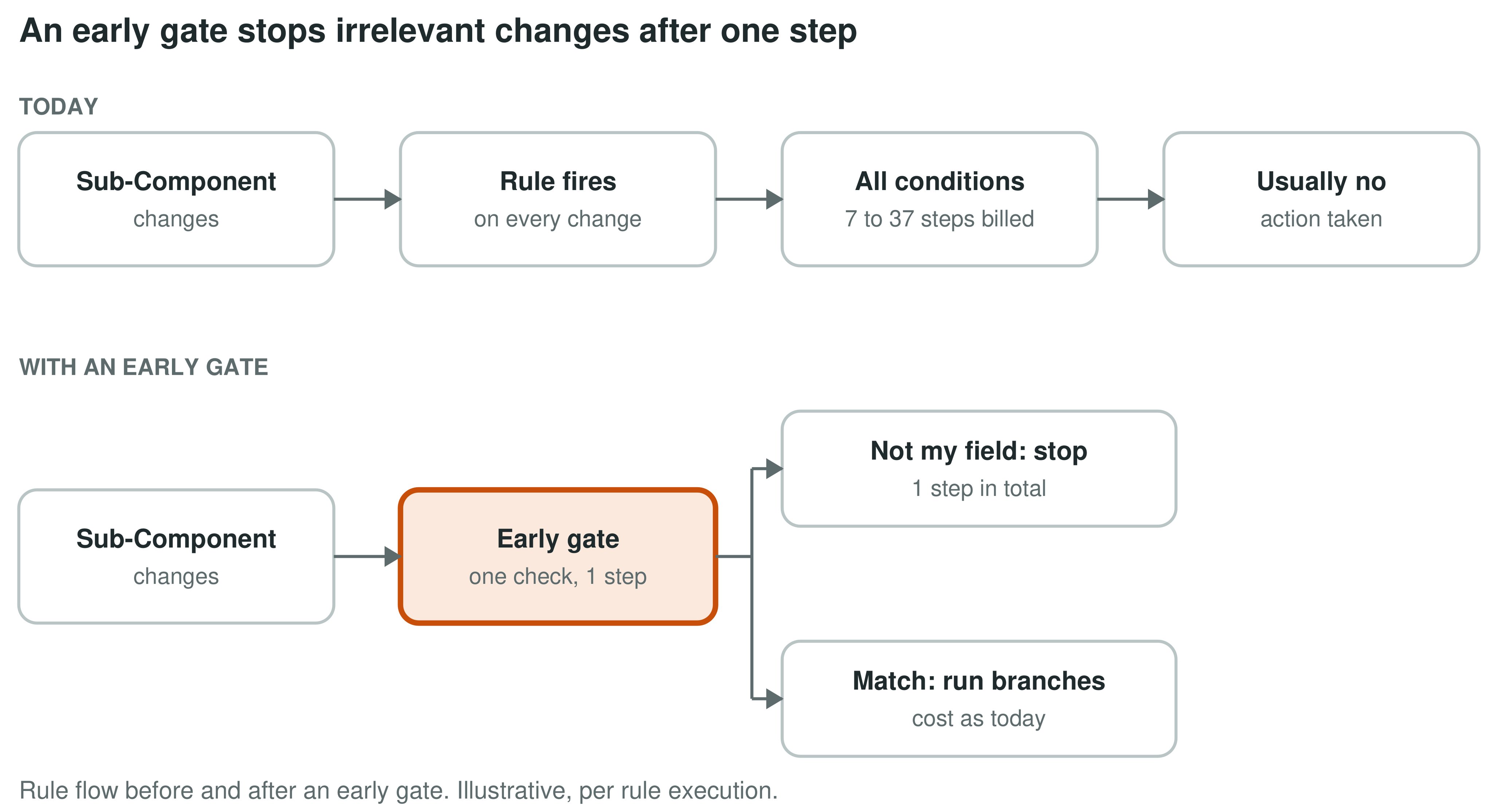
- The 40 highest-usage rules shared the same design: a broad trigger, no early check to ask “is this change one of mine?”, and a separate branch for every possible value, each with its own condition.
- A change that had nothing to do with a rule still cost 7 to 37 steps to reach “nothing to do.”
The company’s own site showed both sides of the problem. One existing rule already checked for relevance on its trigger, and it cost exactly one step every time it decided not to act. The high-volume routing rules did the opposite, working through every condition first.
Our recommendation was simple and low risk: add an early gate to the top of each high-volume routing rule. This single condition passes only when the change is one the rule actually handles. Irrelevant changes stop after one step, and runs that need to act cost exactly what they cost today. The rules keep doing exactly what they do now.
For a second phase, we recommended consolidating the routing rules. Today, dozens of near-identical rules each run on every change. One routing rule per field, driven by a lookup table of sub-components to assignees, QA and watchers, would run once per change instead of 54 times.
RESULTS: A 68% PROJECTED REDUCTION IN AUTOMATION USAGE
Praecipio’s model covers 709 candidate rules that together account for most of the company’s monthly usage. The early gate alone changes the picture dramatically.
- Automation usage drops from about 77 million to about 24 million steps a month, a 68% reduction.
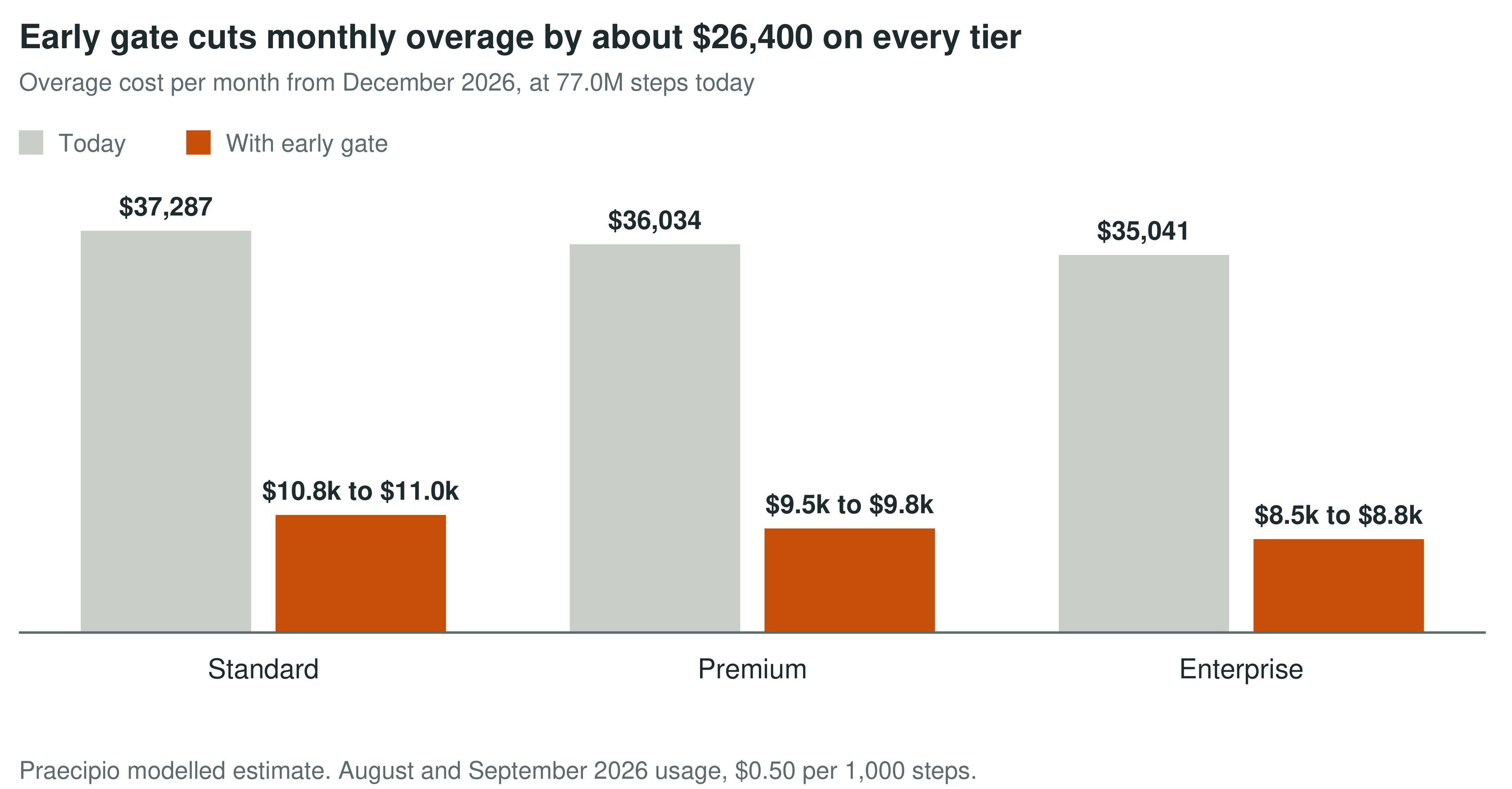
- Projected monthly overage falls from $35,000 to $37,000 to roughly $8,500 to $11,000.
- About $26,400 a month in projected savings on every plan tier, or more than $300,000 a year.
- No automation stops doing its job. Runs that act cost the same as before.
These figures are conservative. The model doesn’t yet include savings from consolidating the routing rules, rules that do nothing 50% to 90% of the time, or scheduled rules, so the full opportunity is larger.
The company now has a clear, prioritized plan well ahead of December 3. The next step is a one-week pilot on its highest-volume routing rules to confirm the savings, followed by a rollout across the remaining rules and a second phase to consolidate them.
What started as a projected five-figure monthly overage became a clear, low-risk plan to pay for the automation that matters, and nothing more.


